
Inspired by a Hallmark card illustration, the Frosty Friends phenomenon officially started in 1980 with the introduction of a new Keepsake Ornament series. Beloved by fans and cherished by collectors, Frosty Friends is now the most successful and longest-running series in Keepsake Ornament history. So, as the spring season is just around the corner, let’s take a look back at this popular winter series’ history.

Illustration by Ruth Moorehead
Stylist Ed Seale is the sculptor most associated with Frosty Friends, but it was Designer/Supervisor Jim Mahon who introduced the concept. Jim was inspired by Master Artist Ruth Morehead’s Christmas cards – featuring two Eskimos rubbing noses together – and began toying with the idea of bringing her illustrations to life.
The series began in 1980, about the time Keepsake’s dedicated art studio was being formed, and Ed Seale joined its small, exclusive group of sculptors. Ed sculpted his first Frosty Friends ornament in 1982, shortly after Jim retired, and created all but a few of the series’ ornaments until his own retirement in 2003.
The characters in Frosty Friends usually include an Eskimo child – whether the child is a boy or girl has always been up for debate – and a charismatic group of animal friends – polar bears, huskies, penguins, reindeer, seals or other enchanting arctic animals.
The ornaments’ artistic style is simple and whimsical, and the theme is always the same – the warmth of fun and friendship in an icy, cold place. It’s something Ed can relate to. “We lived on a farm in Canada,” he recalled. “And the pond was the biggest source of entertainment. When the air was still and the water froze fast, you’d get this clear, perfectly smooth ice. And that was the best.”

Frosty Friends
3rd in the series.
But sculpting ornaments to look like ice didn’t start out so smoothly. The first Frosty Friends ornament Ed made in 1982 shows the Eskimo kid scaling a big icicle. Back then, everything was sculpted from brown clay. “It was really hard to look at the hard brown clay and visualize an icicle,” Ed laughed. “It was all but impossible to work in the subtle little details to make it look like ice.” But craftsmanship means solving problems. Ed solved this one by having a plaster cast made in the rough shape he wanted. And from the plaster, he was able to sculpt the icicle’s details.
After his first Frosty Friends success, Ed would go on to sculpt a lot more. He credits his active boyhood for many of the ideas that kept the series going – though he admits it’s often hard to tell where good ideas come from. “An idea can start anywhere,” Ed said. “Part of it can come from walking through a hardware store. I might match that up with an old memory from childhood. The freshest ideas seem to come from several sources, and you just put it all together.”
Frosty Friends continues to sail successfully ahead, as Keepsake Artists Sharon Visker, Tammy Haddix, Nello Williams, and most recently Tom Best imagine new ways to depict these beloved characters.
Over the past 39 years, Keepsake Artists have tried to follow the same styling, but, as about 10 artists have worked on the popular series, there are slight differences from artist to artist. Tom, who took over the series in 2009, has tried to promote a uniform style during his tenure. “Since I’ve taken over, I’ve been trying to unify the look to a standard and consistency,” Tom said. “We even created a style guide to help other artists create Frosty Friends books and gifts.”

Frosty Friends
30th in the series.
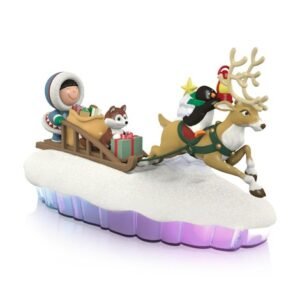
Here Come Frosty Friends
Christmas Tabletop Decoration
In addition to a consistent style, sound and light development forced Tom to think more about how light and music can help tell a compelling story. “I wanted a slight American Northwestern Indian influence to it, so you can hear the flute and drum strongly,” recalled Tom. “And I felt the light aspect had to be the Northern Lights (Aurora Borealis), so that is what you see and hear in the mantlescape or glowing bases.”
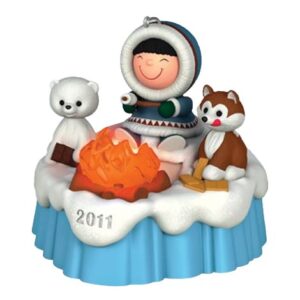
S’more Treats
Incorporating design and movement through new technology was another recent challenge, and S’more Treats, introduced in 2011, successfully integrated both elements. “I had the opportunity to be the one to first bring these characters into the realm of digital sculpting with S’more Treats,” said Nello. “It was one of the most challenging ornaments because of the mechanics that had to be accounted for during the design process. It was also the first Keepsake Ornament that we did that uses a solar cell to power the movement.” After several months of testing – including reverse engineering several toys to see how the technology could be applied to ornaments – S’more Treats came to life after it was attached to a light string. The soft glow from the campfire activated a solar cell that powered the movement of Frosty’s friends, as well as the stick that Frosty used to roast marshmallows. This new technology – a technology that the studio has used in a number of other ornaments since then – was a thrill to Keepsake Artists and collectors alike, as it invoked memories and extended the storytelling aspect of Frosty Friends.
After nearly 40 years of friendship and winter fun, Frosty Friends has appeared on books, itty bittys®, magnets, ornaments, snow globes, socks, stickers, and other gifts. Look for the tradition to continue in 2019 with the release of three new designs including Flight School, featuring a certain flightless Antarctic bird, a miniature igloo complete with a surprise inside and a special 40th anniversary piece.

Frosty Friends
40th in the series.

Frosty Surprise
Miniature
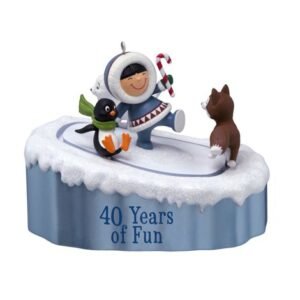
Frosty Friends
40th Anniversary
Part of this post was sourced from: “Frosty Friends, Good Ideas Keep Series Going Strong,” an article that originally appeared in Hallmark Keepsake Ornaments, The Inside Stories From the Artists Who Create Them by John Peterson (2007).
NOTE: The Frosty Friends series (No. 1 – 38) is currently on display at the Hallmark Visitors Center.


Leave A Comment
You must be logged in to post a comment.